
Shape interaction. Create opportunities.
NegoLead’s flagship programme for leaders, negotiators, diplomats, and professionals whose success depends on working effectively with others.
Success rarely depends on knowledge or technical expertise alone. It depends equally on the ability to understand people, interpret situations accurately, remain composed under pressure, make sound judgements, and create opportunities through effective interaction.
Whether leading a team, negotiating an agreement, managing conflict, influencing decisions, building partnerships, or responding to unexpected challenges, professionals constantly operate in environments characterised by uncertainty, competing interests, limited information, and rapid change.
Participants leave the programme with greater confidence under pressure, stronger strategic judgment, enhanced negotiation and leadership capabilities, more effective teamwork, and a broader capacity to create opportunities through resourceful interaction.
This programme develops one of the most valuable professional capabilities for navigating such environments: resourcefulness.
Resourcefulness is the ability to discover, create, and use possibilities for effective action under changing conditions. It combines strategic thinking, behavioural agility, composure, sensitivity, creativity, and practical judgement. Resourceful people do not simply react to circumstances — they shape them.
The programme introduces participants to the principles of strategic interaction—the ability to understand, shape, and navigate relationships among individuals, teams, organisations, and cultures in ways that build trust, create opportunities, resolve differences, and achieve lasting results.
Unlike conventional executive programmes built around lectures, slides, and case discussions, this programme is almost entirely experiential. Participants learn through interaction.
Through a carefully designed sequence of original exercises, strategic games, simulations, and guided reflection, participants experience the dynamics of leadership, cooperation, competition, negotiation, trust, behavioural flexibility, strategic thinking, self-control, and resourcefulness. Every exercise is followed by structured discussion that transforms experience into practical insight and collective learning.
Rather than studying strategic interaction from the outside, participants experience it directly. The programme itself becomes a living laboratory of human interaction.
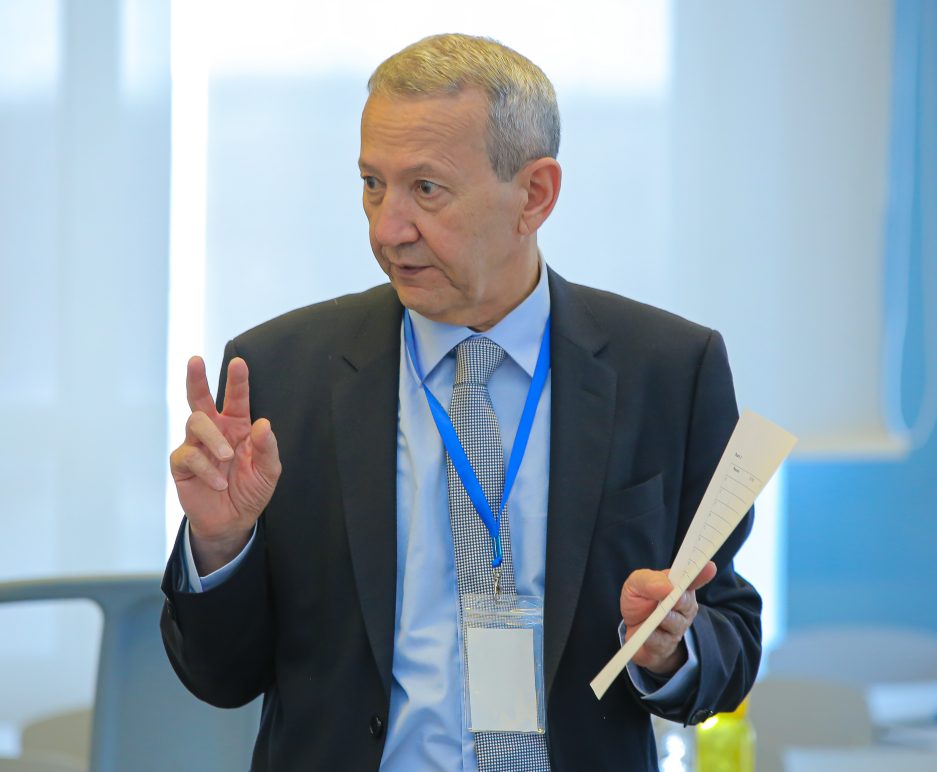
The programme draws on Professor Alisher Faizullaev’s four decades of experience as a psychologist, diplomat, ambassador, negotiation scholar, executive educator, and designer of original experiential learning exercises.
Strategic Interaction and Resourcefulness is NegoLead’s flagship programme. It brings together, within a single learning experience, the central ideas developed across Professor Faizullaev’s work on negotiation, diplomacy, leadership, strategy, psychology, and human interaction. .
Participants explore themes such as:
- resourcefulness as a professional and personal capability;
- reading people and situations accurately;
- confidence, composure, and emotional self-control under pressure;
- assertiveness, sensitivity, and behavioural agility;
- creativity and practical judgement in real time;
- cooperation, competition, and building trust;
- strategic interaction in leadership, teamwork, negotiation, persuasion, and conflict;
- recognising opportunities that others overlook;
- shaping interaction rather than merely reacting to it.
Who should attend?
This programme is designed for anyone whose success depends on working effectively with others.
It is particularly valuable for:
- business leaders and executives;
- entrepreneurs and business owners;
- managers and team leaders;
- diplomats and public officials;
- professionals working in multicultural and international environments;
- consultants, lawyers, project managers, and HR professionals;
- ambitious young professionals preparing for leadership responsibilities.
No previous training in negotiation or leadership is required.
Learning environment
The programme takes place in a sufficiently large room with chairs arranged in a circle. Tables are deliberately not used, as they create distance and inhibit the quality of interaction that makes the learning authentic.
Participants spend much of the programme interacting, moving, observing, reflecting, and learning from one another rather than listening to lectures. No computer, screen, or projector is needed — only a flip chart or whiteboard with paper and markers is required. The facilitator continuously adapts the programme to the group’s dynamics, observations, questions, and emerging insights. As a result, no two programmes are ever identical.
Video recording is not permitted, as it affects both confidentiality and the natural dynamics of group interaction. Photography is welcome before or after the programme.
Programme formats: Half-day programme — approximately 4 hours, one 15-minute break; Full-day programme — approximately 7 hours, lunch break, two 15-minute breaks.
Group size: The optimal group size is 16–30 participants for both programme formats.
The quality of our professional and personal lives depends largely on the quality of our interactions. Resourcefulness enables us not merely to respond to changing situations, but to shape them.